
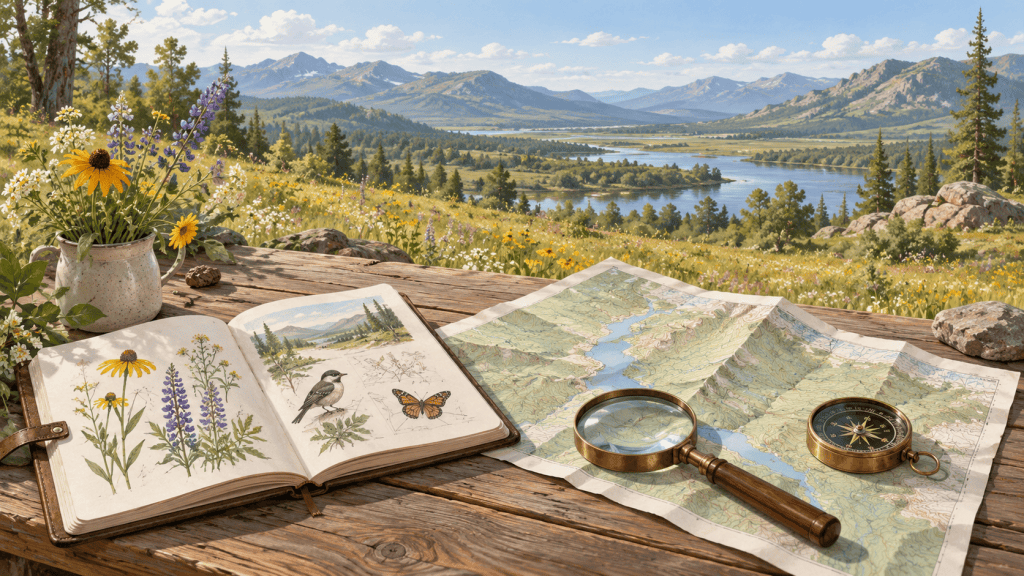
What small thing will I make, which resources can help, and what will I learn by revising it?
Choose a modest project and define what finishing means. Find suitable examples with their context and rights, make an original first version, ask for specific feedback when appropriate, and keep the changes that help you express the idea more clearly.
Evidence checked October 18, 2026 (America/Denver). Version 1.0. Desk review; no hands-on testing.
What this guide helps you do
An original creative-project planning method using museum and university learning gateways. No full course, artwork, individual project, creative result or platform feature was evaluated. Source images and branded exercises are not reproduced;reuse rights require item-level checks.
Choose a small project with a visible finish
Describe a short story, a page of observations, a sketch or another manageable object you want to make. Define its audience, materials, time available and one question you want to explore. Keep the first version small enough to complete with resources already available. A finished draft gives you something concrete to examine;it is not a judgment about talent, a promise of wellbeing or a requirement to share personal experiences.
Collect inspiration with context and rights
Keep a notebook of item links, creators, dates and the feature you want to study. Smithsonian Learning Lab distinguishes individual digital resources from curated collections and describes discovery, creation and sharing tools separately. Use public material as a lead, then check the actual object’s context and rights before copying, adapting or publishing it. A discoverable image is not automatically reusable. No image, account, collection or upload was created for this research. Source: Smithsonian Learning Lab discovery and curation gateway.
Match the learning route to the project and audience
The National Gallery of Art gateway describes looking, discussion and making resources, with audience and school-grade labels. OpenLearn’s fiction description introduces character, setting and genre. Choose a route that matches your starting point and inspect the actual lesson before adopting it. A school resource may need adaptation for an adult learner, and a course description does not establish every lesson’s suitability or a successful outcome. The full courses and dynamic museum filters were not tested. Source: National Gallery of Art education and creative-project gateway.
Make an original first version
Write or draw a first version using your own selected idea and permitted materials. Keep a simple note of sources and decisions as you work. For a short fictional scene, you might identify a character, a place and a change;this is an original planning suggestion rather than a reproduced course exercise. OpenLearn lists recognizing strengths and weaknesses among its learning goals, but no course participation or assessed improvement was tested here. Source: OpenLearn Start Writing Fiction course description.
Ask for specific feedback when it is welcome
Decide what you want a reader or viewer to notice and ask one bounded question, such as where the sequence became unclear. Obtain agreement before sharing another person’s story, image or private information. Feedback describes a response from one audience;you may accept it, reject it or test a different version. No person was contacted and no feedback session occurred in preparing this guide. Public posting is a separate choice with its own access and rights checks.
Keep versions and explain the revision
Save the first version, a revised version and a brief note describing what changed and why. Compare both against your original aim instead of erasing the earlier attempt. Record what remains unfinished and the next experiment you would try. If another person will continue the project, include the sources, permissions, materials and version names they need. This small record preserves practical learning as well as the final object and makes a creative process easier to revisit.
A pathway to practice
- Define the project: Object, audience, limits and finishing point.
- Find useful examples: Context, learning level and item rights.
- Make and reconsider: Original draft and agreed feedback.
- Retain the learning: Versions, reasons and next experiment.
Resources and their limitations
National Gallery of Art education and creative-project gateway
Use it for: Find art-based looking, discussion and making resources with explicit audiences.
Access and cost: Public page is free; account features,downloads,courses,services and reuse conditions require separate checks.
How to use it: Use featured series and audience labels to choose appropriate further learning; adapt your own project rather than assuming every lesson fits.
Evaluation and limits: No substantive revision date established. Static gateway and featured-series descriptions only; dynamic filters/search, courses, field trips and events not tested. Many resources are designed for school grades, families and teachers. No current booking, learning outcome, individual suitability or image-reuse license established.
Alternatives: An original modest art project, local library resources and the actual item’s rights and instructions.
Open National Gallery of Art education and creative-project gateway
OpenLearn Start Writing Fiction course description
Use it for: Choose an introductory writing route and identify a manageable project question.
Access and cost: Public page is free; account features,downloads,courses,services and reuse conditions require separate checks.
How to use it: Read the public description and outcomes; inspect actual lessons, access and personal learning goals separately.
Evaluation and limits: Published August 9, 2012; updated May 14, 2026. Description only; full course, downloads, quizzes and participation features not tested. Account required for some features; no account created. Old August 25 maintenance banner is not a verified present outage. Ratings, scholarship eligibility and credential claims not adopted. No publication or creative-success guarantee.
Alternatives: An original short draft, reading examples, appropriate feedback and a personal revision log.
Open OpenLearn Start Writing Fiction course description
Smithsonian Learning Lab discovery and curation gateway
Use it for: Find museum objects and curated collections as starting points for a creative inquiry.
Access and cost: Public page is free; account features,downloads,courses,services and reuse conditions require separate checks.
How to use it: Explore relevant public material and verify actual item context, rights and platform access before later reuse or collection creation.
Evaluation and limits: No substantive revision date established. Static discover/create/share descriptions only; recaptcha verification appears and interactive/account tools were not tested. Workshop dates/time zones/availability, collection counts, third-party material and efficacy claims not adopted. No universal reuse license; no image copied, account, collection, upload or registration created.
Alternatives: An original notebook of item links and permitted materials, with context and credit retained.
Open Smithsonian Learning Lab discovery and curation gateway
Checklist
- Choose a modest object, audience and finishing point.
- Record inspiration links, context, credits and item rights.
- Check the actual lesson’s level, access and suitability.
- Make an original first version with permitted materials.
- Seek agreed, specific feedback and protect private material.
- Save versions, reasons for changes and the next experiment.
Related guides
Drawing, painting and visual communication (SG-D14-S01); Printing, bookmaking and paper crafts (SG-D14-S03); Photography, film and storytelling (SG-D14-S06); Community arts and creative practice (SG-D14-S08); Personal learning plans (SG-D19-S01); Learning by doing (SG-D19-S02); Philosophy, ethics and ways of living (SG-D36-S01); Relationships, communication and belonging (SG-D36-S04).
From the historical registry to current practice
The printed title is The Act of Creation by Arthur Koestler;the review connects creativity with bringing different frames or experience together. Existing registry title Creative Act corrected from the printed entry while its stable ID and former wording remain documented. Current project steps are original;historical psychological,neuroscientific,perceptual and technical claims not validated. Spring 1969, PDF page 127, printed page 125.
Whole Earth Catalog Spring 1969 archive
For a proposed correction or coverage gap, give the editor the guide ID, disputed passage or missing subject, dated original source and reasoning. Preserve earlier evidence and the editorial decision.
Sources and review notes
Scoped first-pass educational guide; broader coverage remains open. Actual source, person, community, practice, rights and access require separate confirmation. Linked full curricula, articles, courses, studies, media, accounts and services were not comprehensively audited. No individual claim investigation, clinical or legal assessment, conversation, course, creative intervention, personal-data submission, account, purchase, insurance research or provider contact performed.

