
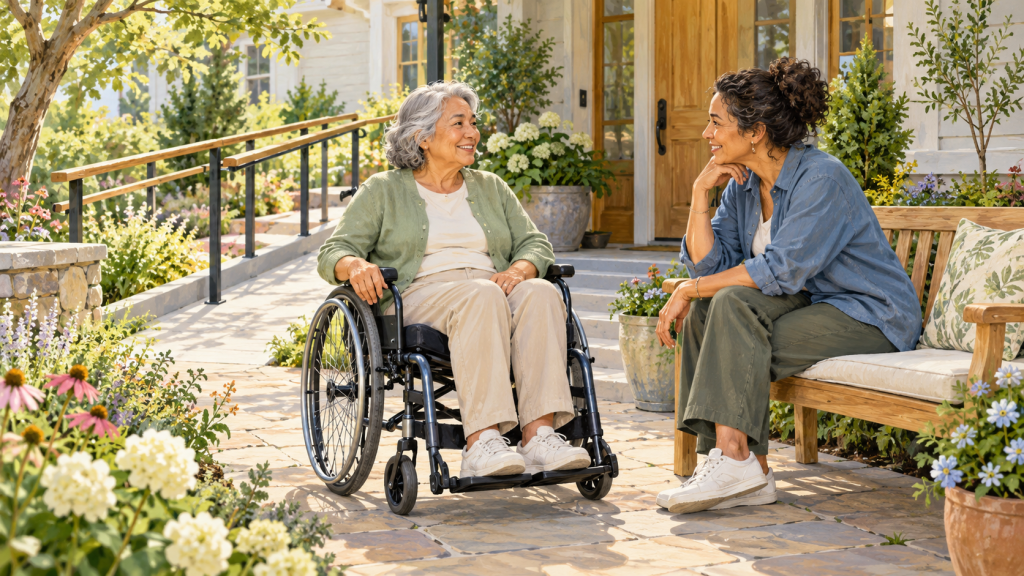
Start with the person, the activity and the place where access breaks down. Record the barrier, agree what would help and involve the right support or technical professional before relying on a change.
Evidence checked October 17, 2026 (America/Denver). Version 1.0. Original-source desk review; no practical testing.
What this guide helps you do
An original barrier-assessment and planning worksheet, not a site inspection, fall-risk assessment, construction design or legal compliance opinion. A private home and a public facility can involve different standards and responsibilities. Individual usability and applicable requirements both need appropriate review.
Begin with the person’s chosen activity
Ask what the person wants to do and where the task becomes difficult: entering, moving around, reaching, seeing or hearing information, using a bathroom or taking part in a service. ACL describes independent living as person-directed. Let the person describe the useful outcome rather than selecting a product first. Source: ACL Centers for Independent Living overview.
Record the whole route
Follow the activity from arrival to completion and leaving, with the person’s permission and appropriate support. Note surfaces, obstacles, lighting, controls, seating, communication and the help currently required. Describe what you observed and what still needs measurement or professional assessment. This worksheet supplies no technical dimensions or pass/fail threshold.
Notice home-environment concerns
CDC’s selected older-adult guidance identifies trip hazards, lighting and supports as home considerations and points to a healthcare discussion. Use those as questions relevant to the actual person. Do not assume that clearing a route alone resolves every disability or fall risk. Equipment and installed supports need suitable selection and installation. Source: CDC home fall-prevention considerations.
Find the right technical basis
The Access Board explains that its ADA guides must be used with the complete standards and distinguishes optional best practices from requirements. Identify the actual place, activity, planned work and responsible professional before relying on a technical proposal. The introduction does not establish whether an ADA duty applies to a particular home or facility, or whether a design complies. Source: US Access Board introduction to ADA technical guides.
Arrange practical support and responsibilities
ACL describes core CIL information/referral, skills, peer-support and advocacy services, with some additional services varying locally. Ask the actual center about useful support, scope and access. For a proposed change, record permission, responsibility, complete cost, maintenance and the professional checks needed. No local service, funding or adaptation was verified here. Source: ACL Centers for Independent Living overview.
Check whether the change works
With the person’s agreement and appropriate professional guidance, assess whether the completed change makes the chosen activity usable. Record remaining barriers and any new difficulty. Keep instructions, maintenance needs and a review date. A technical sign-off and the person’s practical experience answer different questions; retain both where relevant.
A record you can use
| Record | What to write down |
|---|---|
| Person and activity | Chosen task, preferences and desired practical outcome. |
| Place and barrier | Arrival-to-exit route; observed difficulty and unknowns. |
| Support needs | Physical/sensory/cognitive communication needs and existing help. |
| Technical questions | Facility/work context, applicable-source and professional checks needed. |
| Proposed action | Permission, responsible person, cost, installation and maintenance. |
| Usability review | Person’s experience, technical findings, remaining barriers and review date. |
Learning route
- Ask: Start with the person and activity.
- Observe: Describe the route and actual barrier.
- Plan: Check support, standards and responsibilities.
- Review: Confirm usability and remaining needs.
Checklist
- The person shapes the activity and intended outcome.
- Observed barriers and unknowns are recorded separately.
- Home considerations are not a complete accessibility audit.
- Requirements and optional recommendations stay distinct.
- Changes have appropriate permission and professional support.
- Usability, maintenance and remaining barriers are reviewed.
Resources and their limitations
US Access Board introduction to ADA technical guides
US Access Board introduction to ADA technical guides — US Access Board
Use. Use the introduction to identify the relevant standards/guide and responsible design or compliance professional. Keep technical requirements, optional recommendations and individual usability questions distinct.
Access and cost. Public HTML reading. Actual care, appointments, records, equipment, adaptation work and services can have separate costs and conditions; none purchased or tested.
Review and limits. Introduction only; individual chapters, full standards, local building codes and legal authorities not reviewed. The guide says it explains but does not reproduce the standards and labels some best practices as optional. No ADA coverage, private-home duty, measurement, design, permit or compliance conclusion made. No construction or site inspection performed.
CDC home fall-prevention considerations
CDC home fall-prevention considerations — Centers for Disease Control and Prevention
Use. Use the selected home-environment and professional-review portions to note trip hazards, lighting and support needs for discussion with the person and appropriate professionals.
Access and cost. Public HTML reading. Actual care, appointments, records, equipment, adaptation work and services can have separate costs and conditions; none purchased or tested.
Review and limits. Dated January 27, 2026. Selected home-environment considerations only. Medical risk, exercise, supplementation, screening schedules, statistics and linked PDF checklists not evaluated or prescribed. A brief page is not a full accessibility audit, a construction design or a guarantee against falls. No home, equipment or installation tested. Retrieved page shows SSI navigation errors; the selected main content is present.
ACL Centers for Independent Living overview
ACL Centers for Independent Living overview — Administration for Community Living / HHS
Use. Read the core-service and locally variable additional-service descriptions, then ask the actual center about information, peer support, housing/adaptation leads and current service access.
Access and cost. Public HTML reading. Actual care, appointments, records, equipment, adaptation work and services can have separate costs and conditions; none purchased or tested.
Review and limits. Current program overview; no substantive revision date established. Core versus additional local services distinguished; older counts/outcome anecdotes and legal/statutory claims not independently evaluated or adopted. Linked directory, centers, newsletters, plans and PDFs not reviewed. No local service, eligibility, funding, housing adaptation, inspection or appointment verified.
Historical starting point
The Spring 1969 Human Engineering Guide entry describes design around people, equipment, workspace, vision, hearing and body measurements. It supplies a historical prompt to consider the user and task. Today’s disability-led planning and accessibility standards are modern sources. Historical body-measurement averages, sensory generalizations, graphs and technical design figures are not adopted. Locator: Whole Earth Catalog — Spring 1969, PDF page 49, printed page 47.
Related guides
- Assistive devices and adaptive tools — browse the Public Library
- Aging at home — browse the Public Library
- Dental, vision and hearing care — browse the Public Library
Last substantive desk review: October 17, 2026. Sources retain their own dates and geographic limits. Local services and individual products require a fresh check at the time of use. For a correction, retain the page title, source and passage in question.

