
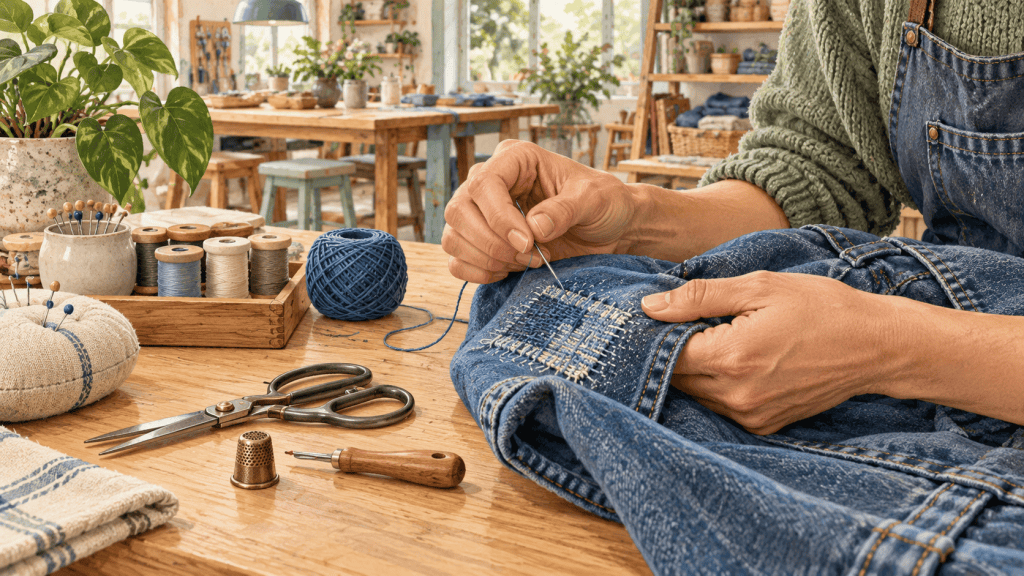
Begin with one ordinary garment and a small repair you can understand. Learn to tell an open seam from damaged fabric, practice on scrap and keep the result easy to inspect.
Evidence checked October 17, 2026 (America/Denver). Version 1.0. Original-source desk review; no practical testing.
What this guide helps you do
Beginner garment assessment, hand-sewing practice and a route to simple household projects. Protective clothing, load-bearing textiles, treasured historic pieces and specialised fabrics need appropriate specialist care.
Describe the damage before choosing a stitch
Look at the wrong side as well as the outside where accessible. Is the seam thread broken while the fabric is sound, is a fastener missing, or are the fibres themselves worn through? Note where the area stretches or takes strain. Do not assume that closing a hole corrects weak surrounding fabric. Take a photograph and ask a skilled mender when the structure is unclear.
Assemble a small kit
Start with a suitable hand needle, thread, scissors, a way to measure and a safe place for pins and needles. The USU supplies guide distinguishes basic tools from advanced equipment and recommends testing marking tools on a scrap. Choose tools for this repair. You do not need to buy every listed accessory, a rotary cutter or a new machine to begin hand-sewing practice. Source: USU basic sewing supplies.
Practice and compare a sample
Use a scrap similar to the garment and practice the selected technique. Check whether the stitches lie evenly, whether the thread draws the fabric into puckers and whether the result can move as the intended area needs to move. USU’s skill samples offer workmanship checks for hems and buttons. Use the complete illustrated instructions or an instructor rather than guessing from a brief description. Source: USU Sewing Skills Handbook.
Match the method to the opening
A simple separated seam and a tear across the fabric call for different decisions. iFixit’s photographed seam guide shows one hand-sewn closure on an upholstered item; use it to understand the example, not as a universal garment method. For a patch, stretch fabric or a complicated lining, ask for help choosing the technique and compatible materials before making permanent changes. Source: iFixit hand repair of a ripped seam.
Check fit, function and remaining weakness
After a modest practice repair, inspect both sides and check normal movement gently before returning the garment to use. Look for pulling, a reopened edge or new damage beside the repair. Record the thread or patch and the method used so the next repairer has a starting point. Follow the garment’s care information; this guide does not establish a washing or pressing temperature.
Build the next skill with a useful project
Choose a small ordinary household project from a reliable pattern and read the whole method before cutting. USU’s directory provides project and handbook links, but each project still needs its own material and use checks. Local U-Fix-It coaching can include mending and minor alterations; confirm the session and bring matching thread, patch fabric or the detached button if you have them. Source: USU sewing project and skill library. Source: Boulder U-Fix-It Clinic directory.
A record you can use
| Record | What to write down |
|---|---|
| Garment and damage | Item, fabric information if known, open seam / missing fastener / damaged fabric. |
| Intended result | What must close, fit, stretch or remain accessible. |
| Method and help | Complete instructions, instructor or repair-clinic question. |
| Practice sample | Needle, thread, material, evenness, puckering and movement. |
| Finished check | Both sides, fit, strain and unresolved weak areas. |
| Repair history | Date, method, materials, care source and next check. |
Learning route
- Read the damage: Identify thread or fabric failure.
- Practice on scrap: Choose tools and a method.
- Make a modest repair: Use complete instructions.
- Inspect and learn: Check movement and record it.
Checklist
- The type of damage is identified.
- The method suits the garment and intended use.
- A scrap sample was evaluated before permanent work.
- Needles and sharp tools are accounted for.
- The finished area is checked on both sides.
- A remaining weakness or specialist question is recorded.
Resources and their limitations
USU basic sewing supplies
USU basic sewing supplies — Utah State University Extension
Use. Read the basic supplies and glossary; start with tools needed for the selected repair rather than advanced equipment.
Access and cost. Free online reading; materials, travel or services may cost extra.
Review and limits. Educational supply guidance; no machine model or reader-specific fabric tested. Sharp tools need secure storage and suitable supervision. Avoid assuming the whole advanced-tool list is necessary.
USU Sewing Skills Handbook
USU Sewing Skills Handbook — Utah State University Extension
Use. Consult the named beginning-level sample for the selected skill, practice on scrap and compare evenness, security and puckering.
Access and cost. Free online reading; materials, travel or services may cost extra.
Review and limits. Older undated skill-sample handbook hosted by Extension; extraction has broken headings and diagrams. Named samples only reviewed. Check the original diagrams with an instructor; no fabric-wide seam dimensions adopted.
iFixit hand repair of a ripped seam
iFixit hand repair of a ripped seam — Jessica Behner and contributors / iFixit
Use. Compare the opening with the photographed example before choosing the technique; practice and check the finished seam.
Access and cost. Free online reading; materials, travel or services may cost extra.
Review and limits. Contributor guide updated January 30, 2023, illustrated on an upholstered item. It is a limited seam example, not universal garment, stretch-fabric or protective-equipment instruction. Affiliate supply links are not required purchases; no practical repair tested.
USU sewing project and skill library
USU sewing project and skill library — Utah State University Extension
Use. Choose one suitable simple project from the directory and read its complete instructions before gathering material.
Access and cost. Free online reading; materials, travel or services may cost extra.
Review and limits. Directory checked, not every linked pattern. The presence of a project does not establish suitability for a particular user, fabric or use. Heat-protective and child-safety projects need additional review.
Boulder U-Fix-It Clinic directory
Boulder U-Fix-It Clinic directory — Eco-Cycle / Boulder U-Fix-It Clinic
Use. Follow the organizer link for a current session and ask about the item, required materials and registration.
Access and cost. Eco-Cycle describes free community events with volunteer coaches and tools. Transport, replacement parts, event capacity and acceptance conditions require confirmation.
Review and limits. No current session booked or attended. The examples of accepted items do not establish that every repair is suitable for a beginner.
Historical starting point
Spring 1969 reviews The Complete Book of Progressive Knitting for explaining yarn and stitch choices beyond abbreviated directions. It also notes weaknesses in the illustrations. The modern learning route keeps that emphasis on understanding a method; sewing repair is an explicit extension. Historical suppliers, prices, garment dimensions and fire-safety assertions are not adopted. Locator: Whole Earth Catalog — Spring 1969, PDF page 60, printed page 58.
Related guides
- Repair networks and right to repair — browse the Public Library
- Knitting, crochet and fibre work — browse the Public Library
- Weaving, spinning and fabric making — browse the Public Library
- Clothing selection and protective wear — browse the Public Library
Last substantive desk review: October 17, 2026. Sources retain their own dates and geographic limits. Local services and individual products require a fresh check at the time of use. For a correction, retain the page title, source and passage in question.

