
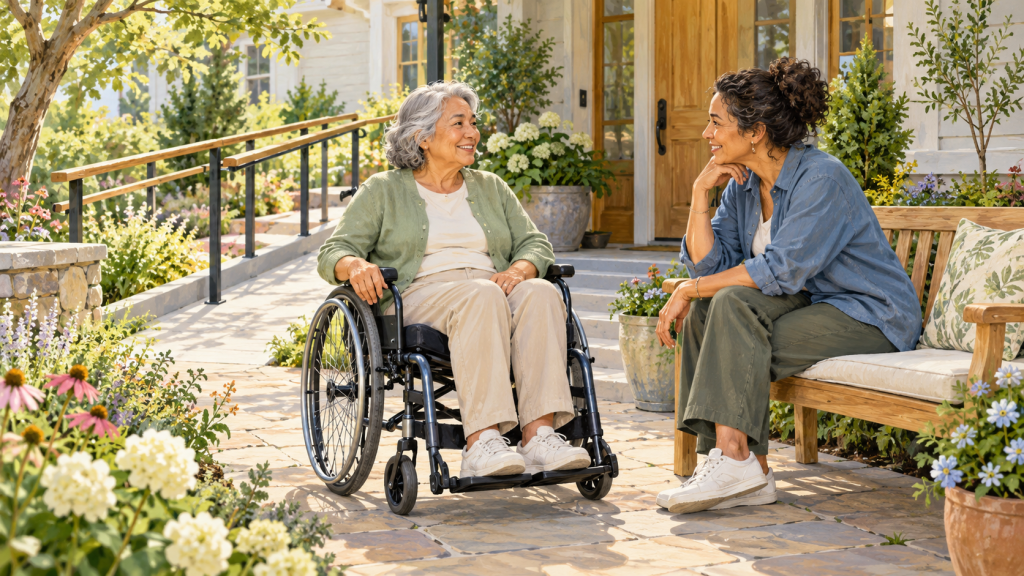
Describe the activity you want to take part in, then identify the barriers and support that would make participation workable. Let the person’s own communication and access preferences lead the discussion.
Evidence checked October 17, 2026 (America/Denver). Version 1.0. Original-source desk review; no practical testing.
What this guide helps you do
Practical access planning across daily settings. Professional assessment and applicable legal duties depend on the actual person, task and organization; this worksheet does not establish compliance or prescribe treatment.
Describe participation in concrete terms
Start with the activity: entering a venue, reading information, following a meeting, finding a route or completing a task. Ask the person what is difficult and what works. Record useful conditions such as pace, lighting, noise, layout, written information or time to respond; avoid inferring someone’s abilities from a diagnosis.
Match the assessment to the goal
MedlinePlus describes rehabilitation in relation to daily physical, mental and cognitive abilities, with individual goals and care planning. If a professional assessment is needed, explain the desired activity and ask which service is appropriate. This guide supplies no exercise, treatment or individual referral decision. Source: MedlinePlus rehabilitation overview.
Plan the actual communication
DOJ’s Title II/III guidance relates effective communication to the interaction’s nature, length, complexity and context and the person’s normal communication methods. Ask what format, aid, service or time would make this exchange usable, then check arrangements with the responsible organization. One method will not fit every person or interaction. Source: DOJ effective communication guidance.
Check the applicable responsibility
The DOJ guidance distinguishes Title II and Title III decision rules and discusses limitations. Identify the actual organization and setting before relying on a legal duty. Ask the responsible access contact or a qualified adviser about the request, available alternatives and any unresolved concern. Source: DOJ effective communication guidance.
Use disability-led community knowledge
ACL describes Centers for Independent Living as sources of information, skills, peer support, advocacy and transition support, with additional services varying locally. Ask the actual center whether it can help with your practical question or point to an appropriate resource. National descriptions do not confirm local service availability. Source: ACL Centers for Independent Living overview.
Check the whole activity and follow up
Agree who will arrange each support, when confirmation is needed and how the person can report a problem. Include arrival, the main activity and departure. After trying an arrangement, ask what worked, what needs changing and who will act on the feedback. Keep technical or clinical questions with the appropriate professional.
A record you can use
| Record | What to write down |
|---|---|
| Activity | What the person wants to do and where |
| Barrier | What interrupts participation in this setting |
| Preference | Communication method, pace and support wanted |
| Arrangement | Proposed support and responsible contact |
| Confirmation | What is agreed, outstanding or needs assessment |
| Follow-up | How to report a problem and review the arrangement |
Learning route
- Name participation: Start with the person’s activity and preferences.
- Describe barriers: Record the actual setting and communication task.
- Arrange support: Confirm an appropriate assessment or access route.
- Review use: Ask what worked and agree any changes.
Checklist
- The person has described the goal and preferences.
- Mobility, sensory and cognitive barriers are considered.
- Communication arrangements fit the interaction.
- The responsible organization and contact are identified.
- Professional or legal questions have a suitable route.
- Confirmation and follow-up are recorded.
Resources and their limitations
MedlinePlus rehabilitation overview
MedlinePlus rehabilitation overview — US National Library of Medicine
Use. Describe the activity, setting, barriers and preferred outcome; ask an appropriate professional whether assessment or rehabilitation support fits the actual need.
Access and cost. Public HTML reading. Devices, assessment, training, services and professional advice may have separate charges or eligibility conditions; actual costs and availability were not checked.
Review and limits. Last updated September 21, 2025. Selected definition, goal and care-team portions only. Linked therapies, exercises, trials, providers and studies not reviewed. No condition, diagnosis, treatment, referral need or individual rehabilitation outcome assessed.
DOJ effective communication guidance
DOJ effective communication guidance — US Department of Justice / ADA.gov
Use. Describe the communication task, normal communication method, context and what would make the exchange usable. Check the applicable entity, guidance and legal requirements before relying on a particular duty or solution.
Access and cost. Public HTML reading. Devices, assessment, training, services and professional advice may have separate charges or eligibility conditions; actual costs and availability were not checked.
Review and limits. Last updated February 28, 2020. Informal Title II/III guidance with exceptions and limitations; not an individual legal or technical determination. Full regulations, device performance and a particular organization’s duties were not assessed. Employment and other settings have distinct rules.
ACL Centers for Independent Living overview
ACL Centers for Independent Living overview — Administration for Community Living / HHS
Use. Ask the actual center about information, independent-living skills, peer support and advocacy, and whether locally variable additional services fit the person’s goal.
Access and cost. Public HTML reading. Devices, assessment, training, services and professional advice may have separate charges or eligibility conditions; actual costs and availability were not checked.
Review and limits. Last modified September 29, 2026. Core and additional-service overview rechecked; older counts and outcome anecdotes not adopted. Directory, providers, plans, linked PDFs, eligibility, funding, local services and appointments not verified. Previous resource/source/claim identifiers and baseline captures retained.
Historical starting point
The Spring 1969 Human Engineering Guide review considers people, equipment, vision, hearing and workspace. Modern person-directed access planning extends that theme. Historical averages, sensory claims, diagrams and technical figures are not adopted as current disability assessment, design or communication standards. Locator: Whole Earth Catalog — Spring 1969, PDF page 49, printed page 47.
Related guides
- Assistive devices and adaptive tools — browse the Public Library
- Accessible homes and public places
- Participation and disability rights — browse the Public Library
Last substantive desk review: October 17, 2026. Sources retain their own dates and geographic limits. Local services and individual products require a fresh check at the time of use. For a correction, retain the page title, source and passage in question.

