
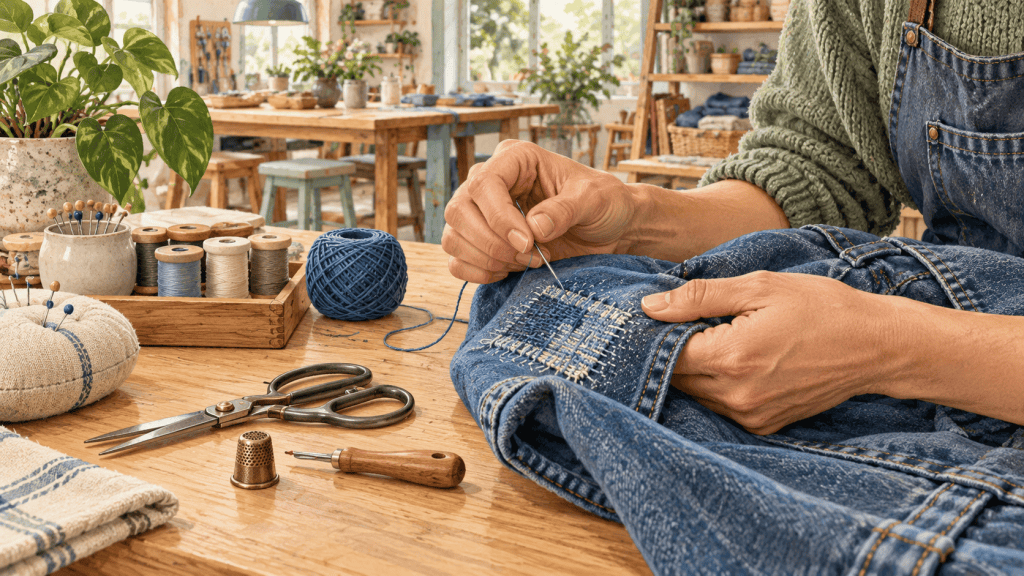
Choose one craft, one yarn and a small practice sample. Learn how your stitches behave before committing time and material to something that must fit.
Evidence checked October 17, 2026 (America/Denver). Version 1.0. Original-source desk review; no practical testing.
What this guide helps you do
An introductory learning and project-planning route for knitting and crochet. It complements complete illustrated instructions; it does not cover all fibre crafts, advanced patterns or safety-critical textile uses.
Choose one first learning route
Use either the knitting or crochet handbook for your first sample and follow its basic skill sequence. Keep the relevant page and your place in the instructions visible. A teacher or practice companion can help you identify a stitch and undo a mistake without losing the whole piece. Choose an ordinary practice rectangle rather than beginning with a garment whose fit depends on many measurements.
Record the yarn and the tool
Save the yarn label or a photograph, including fibre content, amount, dye lot and care instructions. Record the actual needle or hook size in millimetres and any other size marking. Labels and category names are starting information, not a guarantee that two yarns behave alike. The knitting handbook advises checking care compatibility when combining yarns and watching for dye-lot differences. Source: Utah 4-H Knitting Handbook.
Read the pattern before buying the full quantity
Find the finished measurements, materials, tool sizes, stitch definitions and gauge in the selected pattern. Make a list of unfamiliar abbreviations. Check the pattern’s own definitions rather than transferring a term from a different source. The industry yarn-weight reference offers starting ranges, but it expressly gives priority to the pattern’s gauge. Do not infer a full project quantity from a practice sample alone. Source: Craft Yarn Council yarn-weight guidance.
Make a gauge sample and measure consistently
Use the intended yarn, stitch and tool to make a sample large enough to measure away from the edges. Let it relax, then count stitches and rows over the stated span without stretching it. Record the measured span as well as the count. The USU handbooks explain how to compare this result with a pattern and repeat a sample after changing tool size. Follow the pattern’s care or blocking directions when those affect its gauge. Source: Utah 4-H Knitting Handbook. Source: Utah 4-H Crocheting Handbook.
Use the sample as a small calculation
Suppose, only as an arithmetic example, that your sample has 20 stitches over 10 centimetres. That is 2 stitches per centimetre, so 40 stitches would span about 20 centimetres if the same stitch density were maintained. This estimate is not a cast-on instruction: edges, repeats, shaping and stitch changes may alter the result. Record both stitch and row counts so a later comparison uses the same basis.
Finish, reflect and choose the next project
Count your work periodically and mark where the instructions change. Compare the sample with the intended dimensions and note where you gained or lost stitches. Keep it with the label, tool size and notes. Once the basic method is comfortable, choose a modest complete pattern and ask a teacher to check unfamiliar steps. Keeping a useful sample makes the next project easier to plan than relying on memory.
A record you can use
| Record | What to write down |
|---|---|
| Learning route | Knitting or crochet; handbook, pattern and exact version/page. |
| Yarn | Fibre, category if stated, length/weight, dye lot and care label. |
| Tool | Metric needle or hook size and any other marking. |
| Target gauge | Pattern stitch, stitch count, row count and measurement span. |
| Observed gauge | Actual count and span; relaxed/cared-for condition; sample date. |
| Next trial | Keep or change tool; new sample result; question for teacher. |
Learning route
- Choose a route: Use one complete set of instructions.
- Label the materials: Record yarn and tool size.
- Make and measure: Compare a repeatable sample.
- Keep the sample: Plan the next modest project.
Checklist
- The pattern and its definitions are identified.
- The yarn label and metric tool size are saved.
- Stitches and rows use a recorded measurement span.
- The sample was measured without stretching.
- A changed tool has a fresh comparison sample.
- The next project matches the skills learned.
Resources and their limitations
Utah 4-H Knitting Handbook
Utah 4-H Knitting Handbook — Utah State University Extension
Use. Read Tools and Yarn & Gauge, then use the basic stitch illustrations with a teacher or practice companion.
Access and cost. Free online reading; materials, travel or services may cost extra.
Review and limits. 2012 publication re-accessed today, not newly issued guidance. Some descriptions of available tools are dated. Shortened links and charity lists were not checked. Illustrations and the selected pattern remain necessary; no whole-book or finished-project test.
Utah 4-H Crocheting Handbook
Utah 4-H Crocheting Handbook — Utah State University Extension
Use. Read Yarn & Gauge and the beginning stitch instructions, then count stitches and rows in a repeatable sample.
Access and cost. Free online reading; materials, travel or services may cost extra.
Review and limits. 2012 publication re-accessed today. Historical external links, charity lists and every pattern were not checked. Follow the selected pattern definitions and diagrams; no physical project tested.
Craft Yarn Council yarn-weight guidance
Craft Yarn Council yarn-weight guidance — Craft Yarn Council
Use. Use the category table as a starting reference, then follow the actual pattern gauge and record metric tool size.
Access and cost. Free online reading; materials, travel or services may cost extra.
Review and limits. Industry organization rather than independent product evaluation. The page announces a new size 8 while its displayed table remains 0–7; no complete category enumeration is adopted. Symbols are not reproduced. Gauge ranges are guidelines; check the selected pattern.
Historical starting point
Spring 1969 reviews The Complete Book of Progressive Knitting for explaining yarn and stitch choices beyond abbreviated directions. It also notes weaknesses in the illustrations. The modern learning route keeps that emphasis on understanding a method; sewing repair is an explicit extension. Historical suppliers, prices, garment dimensions and fire-safety assertions are not adopted. Locator: Whole Earth Catalog — Spring 1969, PDF page 60, printed page 58.
Related guides
- Sewing and garment repair — browse the Public Library
- Weaving, spinning and fabric making — browse the Public Library
- Clothing selection and protective wear — browse the Public Library
- Measurement, plans and technical drawing
Last substantive desk review: October 17, 2026. Sources retain their own dates and geographic limits. Local services and individual products require a fresh check at the time of use. For a correction, retain the page title, source and passage in question.

